Comics You Should Be Reading: Green Wake

Whether you're looking for a comic with psychological or supernatural themes, or just feel like something other than a superhero book, you should be reading Green Wake. Kurtis Wiebe and Riley Rossmo's title has grown to be one of my favorite titles on the market. Here's why.

Review: Wolverine and the X-Men #1

He's the best at what he does. And what he does...is run the Jean Grey Academy? Professor Wolverine is kind of a catchy name, but I at least hope that his professoring isn't very nice. Check out our take on the latest adventures of Sniktbub and his crazy crew of X-Men here. Bub.

10 Comics That Would Make Great Cartoons

Comics and cartoons go together like a Batman and his current Robin. Cartoons adapted from comic books have a long history of being great, and we here at the 52 Review welcome more of them. Here are 10 comic books we think deserve their own animated series.

Review: Spaceman #1

Brian Azzarello and Eduardo Risso team up again for the 9 issue Vertigo miniseries Spaceman. 100 Bullets is a tough act to follow. Does Spaceman measure up? Find out what we thought of the first issue here, or take advantage of the $1 pricetag and try it for yourself.

Review: The Flash #2

The first issue of The Flash blew us away. Does the second one measure up to the early promise of the series? Or is Barry Allen already starting to slow down? Find out what we thought of Francis Manapul and Brian Buccellato's second issue here.

Showing posts with label Recommendations. Show all posts

Tuesday, November 08, 2011

Comics You Should Be Reading: Locke & Key


When I decided to check out Locke & Key, I made the mistake of only grabbing a few comics. It looked interesting enough, and I figured I'd flip through them the next time I was bored and looking for something to read. One hour later, I had devoured every issue. I was completely immersed in this world, completely attached to these characters, and didn't know how I was supposed to wait to read what came next. I can't remember what I thought Locke & Key would be like. Maybe a neat little comic about a haunted house, or a spooky story about cursed keys. Whatever my expectations were, what I got was so much more.


Locke & Key is one of the most imaginative, engaging comics currently on the market. Writer Joe Hill has built a world that feels incredibly vibrant and full. There are so many ideas in this comic that are only teased at, but it feels like every element of the comic has a complete story behind it. The universe is full of magic, but there's a believably to it that makes even its most fantastic elements resonate. It'd be easy for a comic about a strange house and magical keys to feel cliche, but Locke & Key is something wholly original, from the way its keys are used to the way the story unfolds.


What really separates Locke & Key from so many other horror comics out there is its characters. At times, they feel painfully relatable, and even minor characters feel fully fleshed out. Any character in Locke & Key, even the ones who have only had a few lines, could easily carry a comic all their own, and I'd love to see Hill spin out some characters and develop them further. The characters sometimes make the dumb decisions that all horror characters do, but they feel like natural choices for the character, not unnatural stupidity for plot convenience. It's what keeps them likable and sympathetic, and what grounds the story in the real world.


The art of Gabriel Rodriguez is yet another element that makes Locke & Key so special. I don't think I fully appreciated his work when I first started reading the comic, but every time I re-read my issues, I become more aware of how wonderful his art really is. There are entire stories told only in his backgrounds, and his facial expressions say more than line after line of dialogue could. At one point in the comic, he changes his style to one similar to that of Bill Watterson. It's extremely effective, and it's a testament to his talent that he can utilize a variety of styles without making his art feel like someone else's. Colorist Jay Foto really understands how to bring Rodriguez's work to life, using bright, lively colors that make his panels pop.


Even if you don't normally like horror comics, you should give Locke & Key a chance. There's plenty of subject matter here worthy of a scary tale, but more than anything, it's a story about a family. The relationships between the members of the Locke family err more on the site of painful than saccharine and sweet, but it feels truly authentic, and makes you want to see the family find happiness in spite of everything else. The series is often touching, but those moments come from strange and sometimes twisted places. Sometimes this comic is tremendous fun, and sometimes, it absolutely breaks my heart, but I always enjoy reading it, even the issues I've already read many a time.

I'd recommend Locke & Key to fans of horror, fans of mystery, fans of fanciful tales and everything else in between. It's just a well-written, well paced comic that never fails to suck me in. Locke & Key is somewhat unique in that its stories are told in volumes, which makes it a great book to catch up with in trade. You get a complete, satisfying story in each volume. Just be prepared to go looking for more immediately after you finish what you're reading. Locke & Key is currently in the middle of its fifth volume, Clockworks, and will conclude with volume 6. You can get a peek at the first issue of Locke & Key here, and Locke & Key, Vol. 1: Welcome to Lovecraft can be found on Amazon or at your favorite comics retailer.

By Marceline with 2 comments

Saturday, October 29, 2011

Comics You Should Be Reading: Green Wake


There's no comic quite like Green Wake. Were I pressed to compare it to something, I'd name Silent Hill- both are set in mysterious, horrific towns that seem to draw you towards them. That understand the worst things about you, and the best ways to haunt you. Towns that, for most who come across them, there is no true escape.


The series primarily focuses on Morley Mack and Kreiger, whose unusual appearance has yet to be explained. Like many tales, this one opens with a murder. But as Mack and Kreiger begin their investigation, we soon learn that Green Wake is not an ordinary place. The town's strange nature is revealed to the reader gradually, at a pace that will make them more curious rather than leave them irritated. Some questions receive answers quickly, some are built into bigger mysteries, and some solutions are only teased at. And as readers start to learn more about Green Wake, they may become more and more reluctant to understand the truth at the center of it.

What I love about Green Wake is that in spite of all its strangeness, it's a true detective tale at its heart. When I read it, I feel like David Lynch decided it might be fun to try adapting a Dashiell Hammett classic. Writer Kurtis J. Wiebe, who also created the madcap, mad science gone wrong action series The Intrepids, does a beautiful job of setting the scene with his gripping prose. Every character in Green Wake, even the minor ones, has a clear voice and leaves the reader wanting to know more about them and what brought them to the town. The more I learn about Green Wake, the more fascinating its residents become, and now that the series is an ongoing, I hope we'll have the chance to hear plenty of their tales.


Green Wake was originally intended to be a miniseries, and had ended at issue 5, I would have been satisfied. The town still has many, many mysteries, but character arcs were sufficiently wrapped up, and readers were given enough information to develop their own theories about the town's nature. The series' new start keeps what was great about the original series while taking it in a new direction. In issues to come, it appears we'll be getting more of an ensemble cast, and I expect the introduction of new characters will only deepen the town's mythology. Issue 6 of the series gave us a few tantalizing pieces of information that I think will play a big role in the issues to come.


The art plays as big a role as the writing when it comes to establishing the town's atmosphere. Riley Rossmo's scratchy, dreary style is ideal for the town, and his beautiful shading and colors give readers a real sense of what living in Green Wake would be like. There's more detail in his work than you might notice at first glance. His backgrounds can be surprisingly intricate, and his facial expressions and body language are absolutely incredible. I mentioned before that Wiebe gives every character a unique voice, and I feel like his work shines its brightest near the end of the first storyline, and Rossmo layers on top of that, giving them little tics that make them feel like living, breathing people. I'm excited by the way certain changes to the town since then have changed his style, and I hope future issues give him more chances to experiment.


Now is the perfect time to start reading Green Wake. One storyline has just concluded and another has just begun, so readers can get some gratification before diving into a new sea of mysteries. Green Wake isn't a series for everyone- it's dark, violent, often grotesquely so, and town's unfathomable nature is sure to frustrate some readers. But for anyone who appreciates an unusual, eerie tale, who loves to try and figure things out or just be lost in a mystery, Green Wake can't be beat. Both its art and its storytelling are masterful, and its characters are wonderfully constructed. Green Wake is truly different from every other comic on the market right now, and that's what makes it a must read.

If you're interested in catching up with Green Wake, you can read the first issue for free here. You can also grab the Green Wake Volume 1 TP off Amazon or from your local comic shop.
By Marceline with No comments

Tuesday, October 18, 2011

Comics You Should Be Reading: Daredevil


Daredevil is a character I've never really been able to get into. On paper, he totally seems like the sort of hero I'd enjoy. I'm a big fan of street level superheroes, and I really dig the super senses gimmick. But when I've tried to pick up a Daredevil comic and read, I haven't really enjoyed myself. It's not that the stories are bad- I've tried some of the most acclaimed Daredevil runs- it's that they weren't fun to read. When I've read Daredevil, I've felt like the writers are more interested in showing me how miserable Matt Murdock can be, and aren't as concerned with showing me how awesome he can be. There's plenty of room in the world for a good, angst ridden cape comic, but that's not the sort of Daredevil I want to read.

So why exactly did I wind up picking up Daredevil? The amazing first issue cover helped, but mostly, I gave this a chance because of Mark Waid. Waid has written a ton of terrific stories- Tower of Babel, Kingdom Come, and Born to Run, just to name a few- and I'm willing to give anything he writes at least an issue. And after how great Daredevil's been? I'm going to advise you do the same.


The first issue of Daredevil is incredibly accessible, even if you've never read a Daredevil comic in your life. The basics are laid out for the reader within the first page, and more recent backstory is provided in a natural way as the story progresses. More important than any of that, though, is how much fun this version Daredevil is. Matt Murdock seems determined to squeeze every drop of joy out of life he can, and there's this gleeful energy every time you see him wearing his horns. In past Daredevil stories, artists have gone for a static, photorealistic look, but here, it's pure kinetic energy. Mark Waid's writing does plenty to show readers what a cool character Daredevil is, but Paolo Rivera's art takes it to the next level- he renders the world as Daredevil sees it beautifully, and gives fans some of the best looking pages in comics right now.

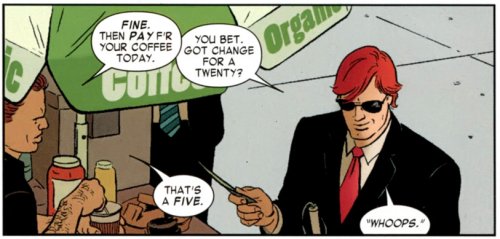
But where I really fell in love with Daredevil was in that same issue's second story. While visiting his father's grave with Foggy Nelson, Matt turns to Foggy and says this:


Those were the exact words I needed to hear at exactly the right time. I've been having a pretty miserable year myself- not Daredevil-tier misery, but I felt like life was going out of its way to find ways to take a crap on me. I needed to be reminded that I couldn't keep wallowing in my own unhappiness, and maybe more importantly, that I didn't *want* to keep wallowing in my own unhappiness. It was both sobering and inspirational, and while I usually take my inspiration from the likes of Captain America and Superman, I was more than happy to take Matt Murdock's words to heart here.


Since then, Daredevil has only gotten better for me. From the brilliant scene when Daredevil wields Cap's shield in issue 2 (it's "like touching a Stradivarius") to the Kirby channeling flashback scenes in issue 3, every issue has been a blast to read and left me with a smile on my face. The comic is only 4 issues in, and Waid's already wrapped up some storylines and set-up some great new ones. I like seeing Matt just being Matt as much as I love watching him fight as Daredevil, and I'm really enjoying the book's supporting cast, especially Foggy. The twist on Matt Murdock's lawyer background is good enough to carry a comic on its own, and all the other great moments readers get are just a beautiful bonus.


The action scenes in the book are exquisitely choreographed, and I'd love to get a look at some of the scripts.  There's great panel to panel storytelling, great movement, and no shortage of interesting foes for him to go up against. We've already seen him fight Captain America, a villain made of sound, and a lion, and I can't wait to see where the book takes him from here. Sometimes, when a comic throws so much awesome at me right from the start, I get concerned the book will start to lose steam over time, but that's not the case here. Mark Waid's vision for both the character and the comic is so clear, and I have complete faith Daredevil is only going to get better from here.

I honestly can't imagine a person who wouldn't enjoy this comic. There are so few characters out there that seem to enjoy what they do the way Matt Murdock does in this book, and that enthusiasm is absolutely contagious. This book makes my life a little bit brighter each month, and just seeing each issue's newspaper style recap is enough to put a grin on my face. I am not going just just recommend you pick up Daredevil, I'm going to recommend you pick up two copies- because there's probably someone who will love the heck out of it too.

By Marceline with No comments

Tuesday, October 11, 2011

What to Read Next: Batfamily


While I offered some reading recommendations to fans of the new Batman comics a few days ago, there are still lots of other Gothamites to cover. From former Robins to the Birds of Prey, here are some suggestions for what Batfamily fans should read next.


The controversial first issue of Batgirl took Oracle out of her wheelchair and put her back in the Batgirl suit. Fans of the Batgirl concept should check out Kelley Puckett and Bryan Q. Miller's run of the title, while fans of Babs Gordon can enjoy Batgirl: Year One or Birds of Prey. Gail Simone's most recent run on the title feels fairly similar in tone to this. Looking for something to read that doesn't involve Batgirl? Check out these titles:

Ongoing: Angel and Faith, published by Dark Horse Comics


While Barbara isn't on the sort of redemptive quest that Angel and Faith are, all three characters are haunted by their pasts and learning how to move forward. This title is aimed at people who have some familiarity with the characters, but those who haven't read a Buffy comic needn't fear. All necessary information is quickly recapped via flashback before the story moves forward. Christos Gage does a great job mixing action with character moments, and Rebekah Isaacs is a strong artist who's especially skilled at visual storytelling. It's tricky to work with characters people know best from an entirely different medium, but the creative team handles it with ease. I suspect there's a lot of crossover between Buffy fans and Batgirl fans, and this is hands down the best Whedonverse comic being published right now. Angel and Faith just released its second issue, and now is the perfect time to jump into the series. If you'd like to see more of Angel and Faith, you can check out a free preview here.

Concluded: Manhunter


Barbara Gordon isn't the only whip-smart lady vigilante in the DCU. Manhunter tells the tale of Kate Spencer,  a criminal prosecutor who decides to take the law into her own hands. Kate isn't as naturally likable as Babs or many other DC ladies, but in this case, it's a good thing. She's a complex, fascinating character whose motivations and actions feel believable, even in a world full of metahumans. Manhunter never holds back, and it's often a tense and uncomfortable read. Kate's supporting cast is full of fleshed out, lovable characters, and often includes appearances from less used DC characters like Al Pratt, the first Atom, and Obsidian. 
Kate's mostly been written by the very talented Marc Andreyko, and drawn by Jesus Saiz, the current Birds of Prey artist. I don't think all her stories are collected in trade, but there are several volumes available on Amazon for cheap. There are no previews available, but here's a scan from the series' first issue.


If you liked Batwoman #1 and you haven't read Batwoman: Elegy yet, stop reading right here and go pick it up. Batwoman #0 is more of a teaser than anything else, but that's definitely worth grabbing too. While 52 is a wonderful comic that's great as a general read, I wouldn't really recommend it to anyone trying to get a better feel for Kate Kane's characters. I don't think anyone really had a feel for how to write her then. I also highly recommend picking up Chase when it's released- it was illustrated by Batwoman writer and artist JH Williams III, and it looks like he's going to make frequent use of its cast of characters. And beyond that? I suggest you try:

Ongoing:  Daredevil, published by Marvel Comics


Both Batwoman and Daredevil are well written books with wonderfully crafted characters in which the art still takes center stage. While Paolo Rivera and Marcos Martín's panel layouts aren't inventive in the way William's are, they still do some really creative and interesting stuff, like this spread that shows readers how Matt Murdock "sees" the world. Daredevil doesn't have quite the level of atmosphere Batwoman does, but it makes up for it with a relentless sense of fun. If you associate Daredevil endless angst and misery, it shouldn't take long for this comic to change your mind. It's written by the terrifically talented Mark Waid, and every issue so far has been a great one. It's my favorite Marvel title by far, and I hope plenty of Batwoman fans will give it a lookk.

Concluded: Promethea


With a creative team like Alan Moore and JH Williams III, it goes without saying that Promethea is a terrific book. This is an incredibly smart and stunning comic that gives readers a sense of how Moore perceives all things mystical. The comic follows Sophie, a college student, as she takes on the role of mythical warrior Promethea. It frequently deals in the fantastic, and allows Williams to show off his skill for drawing in a variety of styles. His page layouts here are even more elaborate than they are in Batwoman, and the plot itself is very experimentive. Themes like sexuality, religion, and philosophy play a big part in the stories, as does the nature of comics. There are all sorts of strange and compelling characters, from the Five Swell Guys to the Weeping Gorilla. It's beautiful to look at, a really great read, and I think fans of Batwoman will absolutely appreciate it. 


Judd Winnick is a writer who's very hit or miss for me, and Batwing was a hit. I really enjoy the character, the setting, and the superhero history he's started to establish. While Batman Inc, the comic in which David Zamvimbi originated, seems like an obvious recommendation, the character is actually barely featured there. He's pretty much brand new, so I'll skip straight to my suggestions:

Ongoing: DMZ, published by DC's Vertigo imprint


Mentioning DMZ here feels like a little bit of a cheat- the series ends this December- but it's still a great read that fans of Batwing should really enjoy. The comic is set in a war-torn but not too distant future in which Manhattan has become a demilitarized zone. For the most part, we see the story through the eyes of photojournalist Matty Jones, who covers the plight of Manhattan citizens. The situation is always portrayed in a plausible way, which makes the book's story that much more compelling. Brian Wood takes a simple concept and turns it to an intense and fascinating tale. Riccardo Burchielli's art adds to the comic's atmosphere, and his work on the more damaged and defaced parts of the city is especially compelling. Most of DMZ is available in trade form, and I highly recommend trying to catch up with the story while you still can. 

Concluded: Christopher Priest's Black Panther


Black Panther is a character who only works for me with the right writer, and it doesn't get any better than Christopher Priest's run on the comic. He makes the politics of Wakanda fascinating even when T'Challa himself is away from his homeland, and  packs the book with great action and strong characterization. There are several different artists during the book's run, but it's Joe Jusko's stunning painted pages that really stand out in my memory. Black Panther obviously isn't involved with the Batman Inc initiative, but it almost feels like he could be. Throughout the series, he comes up with these marvelous, Batman-esque contingency plans, and it's a blast to see all the pieces come into place. If Batwing turns out to be as half as good as Priest's Black Panther was, it's in a pretty good place.


Selina Kyle works best for me in small doses, so needless to say, Catwoman #1 wasn't really my thing. Any fan of the artwork in this title or Catwoman herself should check out Gotham City Sirens, a Guillem March illustrated book which also featured Harley Quinn, Poison Ivy, and the Riddler. For those who'd like to see a different take on the character, I recommend Ed Brubaker's run, which features some great art from Darwyn Cooke. And for those who want something else, these are the books I'd recommend:

Ongoing:  Executive Assistant Iris, published by Aspen Comics


Those who checked out Catwoman because they wanted to see a tough, badass hottie kicking ass would be wise to check out Executive Assistant Iris. The series' title character is a combination secretary, bodyguard, and assassin that seems to get more chances to use the violent side of her skillset than the administrative one. This series isn't a masterpiece, but it's a lot of fun, especially when we get to see more of the comic's supporting cast and Iris' backstory. Eduardo Francisco's art has a pin-up quality, but he never fails to make the executive assistants look like they really could kick your ass. Some people may be put off by Iris' personality in the earliest issues, but I promise, she has plenty of growth as the series goes on. You can read the first issue for free here.

Concluded: Madame Mirage


Madame Mirage was a six issue series written by Batman: the Animated Series' Paul Dini and illustrated by Kenneth Rocafort, who is currently working on Red Hood and the Outlaws. Set in a world where all superheroes are manmade, Madame Mirage uses her various powers- including mind control, shapeshifting, and the creation of illusions- to confuse and eventually defeat the various enemies she goes up against. As the cover makes clear, the series is heavy on cheesecake, but it's an old fashioned pulp comic at heart. Madame Mirage was primarily based on The Shadow, and there's a sort of old fashioned feel to the comic in spite of its somewhat futuristic setting. Madame Mirage herself is a lot of fun, mostly because she seems to really enjoy what she does. You can check out Top Cow's trailer for the series here.


If you liked Nightwing #1, you're in luck! The new series is very close in tone most of what came before, and Nightwing ran for hundreds of issues. I'd also recommend taking a look at Gates of Gotham, which Nightwing writer Kyle Higgins co-wrote with Batman scribe Scott Snyder, as well as Supreme Power, which Higgins wrote for Marvel. If that's not enough, here are a few more suggestions:

Ongoing: Mysterious Ways, published by Image Comics


The obvious recommendation here is Daredevil, but since I already suggested that to Batwoman fans, I'm going a little bit more off the beaten path and suggesting Jason Rubin's Mysterious Ways. If you're intrigued by the "is Dick Grayson a serial killer" plot over in Nightwing, then I think you'll be equally interested in the "is he or isn't he crazy" story Mysterious Ways sets up. Our protagonist is an alcoholic former cop under suspicion for them pretty brutal murders. At the same time, he begins to discover he has supernatural powers- or maybe it's all in his head. This comic is a lot more decompressed than I like my serialized stories to be, but it's still got neat ideas and some nice art from New Guardians penciller Tyler Kirkham. You can take a look at the comic here.

Concluded: Denny O'Neill's The Question


On the otherhand, if what you're looking for is a really great street level vigilante comic, it doesn't get much better than Denny O'Neill's The Question. The Question may not have Dick Grayson's acrobat background, but when you've received training from Richard Dragon, you can bet there are some great looking action scenes. Still, what really makes The Question shine for me is the way Vic Sage perceives the world. He's not awkward in the way he sometimes was in Justice League Unlimited, but he has a very strange way of thinking that's really fun to read. Sometimes, you get the sense The Question and Vic Sage are two different people, and the question of how much his mask changes him is one that intrigues. I especially like his occasional interactions with other members of the DCU, like Batman. This series came out during the 1980's but it's aged wonderfully, and is available in trade paperback form.


Much like Batgirl, there are plenty of easy recommendations to make for fans of the new Birds of Prey. The old Birds of Prey series are a great bet, as is writer Dwayne Swierczynski's work with Marvel. While she hasn't made a true appearance in the new series yet, those intrigued by Katana can check out the Outsiders, the comic in which she originated. Here are a few more suggestions:

Ongoing: Heroes for Hire, published by Marvel Comics


Soon to be re-launched as Villains for Hire, Heroes for Hire is the closest thing to a team of alleged supercriminal hotties that Marvel's got. Both books are full of fun characters, with Misty Knight filling a role similar to what Oracle did in the old Birds of Prey. Most of the characters here are fairly street level, but there's plenty of flash, excitement and fun. The art quality of the series is really up and down, but writers Dan Abnett and Andy Lanning are consistently great. Best of all, Heroes for Hire had a reboot of its own about a year ago, so there's very little for new readers to catch up with. If you really want to start at number 1, you can wait till November when Villains for Hire #1 is released. 

Concluded: Secret Six


If what you're really looking for is a dysfunctional family dynamic, there's no book finer than Secret Six. The team is made up of former villains who'll take on any mission for the right price. Unfortunately, they frequently discover they have more morals than they'd prefer. Even as the team expands beyond the 6 mentioned in the title, every character remains so well-crafted, so perfectly characterized, and so lovable. The characters realize they're broken, damaged, and doomed people, but they keep living their lives all the same, even when damnation itself is staring them in the face. This was the series from the old DCU that it hurt most to lose, and I really look forward to seeing it brought back anyway possible. For now, you can read the series in trade form. Secret Six trades may occasionally be hard to get a hold of, but they're re-printed frequently, so you should be able to acquire whatever volumes you need.


Red Hood and the Outlaws was a bit of a strange book. In some ways, it felt like three different comics, and I want to recommend a book for each of the issue's aspects. For now, I'll suggest that Red Hood fans read Under the Red Hood if they haven't already, and that those curious about Starfire check out R.E.B.E.L.S., which features one of my favorite takes on the character. For a book that matches the books's action-comedy meets sex romp meets underground mystical secret society conspiracy feel? The best titles I can come up with are these:

Ongoing:  The Goon, published by Dark Horse Comics


If you're looking for a slightly schizophrenic, sometimes offensive, frequently hilarious comic full of beat em up action, than The Goon is the book for you. The longrunning series is written and illustrated by the eccentric Eric Powell, is often weird but always a blast to read. Goon and his sidekick Franky are always finding someone interesting to fight, and the comic is full of colorful characters. From a Spanish speaking monster turned manservant to the never seen (but frequently mentioned) Charlie Noodles, the weird world of The Goon is wonderfully fleshed out. I'd definitely describe The Goon as a fun comic, but that doesn't mean it's not dark- there have been some truly brutal moments over the course of the series, and more than a few scenes that made me squirm. But even when the comic's taken a turn for the miserable, The Goon manages to leave me with a smile on my face. You can check out the comic for free here.

Concluded: Nextwave


The tragically shortlived Nextwave had it all. Excitement! Explosions! Naked ninjas and Wolverine monkies and broccoli men! Nextwave never tried to be anything deep- it just wanted be silly, fun, and revel in the craziness of the comic book world. Nextwave doesn't really feel like it's set in the Marvel universe, and the series takes full advantage of that, portraying major heroes in fairly out of character ways and blatantly parodying others. At one point, we meet Charlie America, a would-be super hero allegedly created from Steve Roger's superpowered pee. The comic bucks the trend of decompression, featuring nothing but 2 issue arcs. This thankfully helps the 12 issue series to feel a little longer than it actually is. If you like fun, you should probably read this comic. If you don't like fun, you should probably read this comic and see if it changes your mind. If you're still not convinced, click here.

That's it for the Batfamily! Check back later this week for Superbook recommendations.

By Marceline with No comments

Saturday, October 08, 2011

What to Read Next: Batman


So you read some of the new 52 books. You liked some of the new 52 books. Now you want to know what to read next. Tracking down comics by the same author is always a safe bet, but I want to give readers some suggestions that are a little more unexpected. This will be the first in a series of posts that provides recommendations for fans of all of DC's relaunch titles. Today, let's go over the Batman books.


Batman #1 was my favorite of the Batman titles, and one of my favorite relaunch books in general. Before following any of these recommendations, you should look up Scott Snyder's other Batman tales. His Detective Comics run, which will be collected as Batman: The Black Mirror, has a lot in common with the story he's spinning here. Gates of Gotham, a miniseries he wrote with Kyle Higgins, is a great introduction to the extended Batfamily, and provides some Gotham history that may be relevant in future Batman issues. But if you've read those and are looking for something new, here's what I'd suggest:

Ongoing: The Green Wake, published by Image Comics. 


The Green Wake is a smart, fascinating detective story that demands to be read over and over again. Green Wake, the town the series takes its name from, is small in comparison to Gotham, but it's every bit as sinister. Much like in Batman #1, the town feels like a character in the story, and writer Kurtis Wiebe does a terrific job bringing it to life. Fans of Greg Capullo should really appreciate the work of artist Riley Rossmo. Rossmo fills every panel with emotion and atmosphere, and takes an already compelling story to the next level. The series' first storyline just concluded, and now is the perfect time to get into the series. You can check out the first issue for free here.

Concluded:  Batman: Gothic


Gothic is an oft forgotten Batman story, but it's one of my favorites. Originally published as part of the Legends of the Dark Knight series, the series sheds a fascinating light on Bruce Wayne's childhood, and takes full advantage of the Gotham setting. Unlike Batman #1, Gothic features strong supernatural elements, but the book feels very grounded in reality in spite of that. To me, it's one of the best looks at Batman's motivations we've ever gotten, and reading it will really show you just how far the character has come. Grant Morrison told this tale back in 1990, long before the start of his bat epic, but you can see seeds of his ideas here. His Batman is every bit the badass detective we know and love, but manages to feel very human and vulnerable in spite of that. Klaus Janson's art work is reminiscent of Neal Adams Batman art from the 1970's. It's simplistic in comparison the level of detail in Capullo's pages, but it still adds plenty of mood to the story. Because this comic is so old, it's easy to get on the cheap, and can usually be snagged for around $10 on Amazon.


Anyone who dug the first issue of Batman and Robin should do themselves a favor and check out the series' first 3 volumes. The dynamic between Dick Grayson and Damian is terrific, and there are some big payoffs to the series various mysteries. If you're interested in where Damian came from, you'll want to read Batman and Son, or the book's Wikipedia page. You can also get some backstory from the 1987 book Son of the Demon, but there are some pretty glaring continuity differences. And if you're looking for something a little more unusual, than check out:

Ongoing: Invincible, published by Image Comics


Frequently compared to Dragonball Z, Invincible gives readers a look at what being the son of a superhero might be like. On the surface, the series seems much more lighthearted than Batman and Robin is, but the series takes a darker turn pretty quickly. The comic is written by Robert Kirkman, who is best known for his work on The Walking Dead. The series blends over the top superheroic action with moments that feel very true to life, and Kirkman always injects his comic with plenty of humor. Artist Cory Walker has a slightly cartoony style that fits well with the tone of the series, and does a great job with the book's action scenes. Invincible has been running since 2003, which may be intimidating to new readers, but the book's early volume can be obtained cheaply and easily. You can check out a fully voiced, motion comic version of series for free here.

Concluded: Batman: Dark Victory


Dark Victory features Dick Grayson, not Damian Wayne, but there's no book that will give you a better understanding of why Batman needs a Robin. While Dark Victory is a mystery tale, it's a character study at heart, and shows of Batman's weak points in a way few series are willing to do. For me, this is probably the best work Jeph Loeb has done, and I wish he'd write more stories like this one. Like many of Loeb's Batman tales, it utilizes a large chunk of Batman's rogues gallery, and it's a great way to brush up on the basics. Tim Sale is an enormous talent, and it's a crime that he's illustrated so few comics. He has a noir-esque style that suits Batman beautifully, and some of his splash pages are really stunning. I've heard several people say that reading this changed their opinion of Robin, and I hope it can do the same for you. Before reading Dark Victory, I'd recommend reading Frank Miller's Batman: Year One and The Long Halloween, another Loeb and Sale collaboration. 


I'm not the biggest fan of Tony Daniel's Batman stories, but if you like them, there's plenty for you to enjoy. He began writing the series back in 2009, and a collection featuring some of his work titled Batman: Life After Death comes out later this month. Daniel is also writing another of the 52 books, The Savage Hawkman. Fans of his artwork can check out stories like Batman R.I.P. or Battle for the Cowl. If you're looking for something beyond that, try:

Ongoing: Severed, published by Image Comics


Severed, penned by Batman scribe Scott Snyder, is a great read for anyone who wants something creepy and mysterious. The series, which Snyder describes as "historical horror", is primarily set at the turn of the century, and features a truly terrifying villain. He's not The Joker, but he's every bit as unsettling. We see just enough of him to be afraid, but he's in the shadows enough to leave us wanting more. This is the sort of comic that can appeal to people in a lot of different ways. It's a beautifully constructed comic, but relies enough on old school horror movie cliches to make this fun for someone who wants a lighter, but still scary read. Readers who loved the intensity of the Detective Comics cliffhanger should love some of the mysteries that are teased at here. With every issue, Snyder's left me wanting more, and I'm so excited to see how the story pays off. The art from Attilla Futaki is absolutely stunning, and should appeal to many who enjoy Daniel's artstyle. Severed's third issue was just released, and it should take no time for readers to catch up. It's the sort of comic that really sinks its teeth into you.

Concluded: Hush


Tony Daniel's art style is pretty heavily influenced by Jim Lee's, and Hush is some of Lee's best work. This title is one of the most frequently recommended Batman books, and for good reason. Not only does it introduce readers to many members of the Batfamily and Batman's rogues gallery, it's also chock full of fanboy bait. From Batman fighting a mind controlled Superman to villain team-ups, the comic is full of the sort of moments that many readers can't wait to see. Everything people like about Jim Lee's art is on display here, but he also experiments with his style in a very cool way. His watercolor work is stunning, and injects a lot of emotion into the scenes that make use of it. The violence here seems tame in comparison to what we've seen in Detective Comics, but it's still packed full of action. Because Hush is such a popular book, you've got a good chance of finding this one at your local library.


David Finch was telling Batman stories in The Dark Knight before the reboot, and grabbing those issues should be the first stop of anyone who liked this. The earlier Dark Knight issues had a bit of a supernatural bent, but they feature the same David Finch artwork that people know and love. Anyone looking for more of his art should check out his work on Moon Knight and the Ultimatum miniseries. The other Batman stuff he's illustrated isn't super accessible to newer readers, but that doesn't mean they can't appreciate his spreads in Batman: The Return. If you're looking for a story not drawn by David Finch, I'd recommend:

Ongoing: Damaged, published by Radical Comics


Damaged is the tale of two brothers whose lives took very different paths. One of them is among the San Francisco PD's finest, while the other is a vigilante who borrows more from the Punisher than Batman. Written by David Lapham, Michael Schwarz, and John Schwarz, this story lets you see the sort of law versus viglante conflict you may have enjoyed in The Dark Knight's first issue, and has some pretty compelling elements for fans of both hardboiled detective stories and horror fiction. The artwork from Leonardo Manco is a little too static for my tastes, but it's beautifully rendered, and I think David Finch fans will really appreciate it. The art is detailed enough to justify several repeat readthroughs, and the book's team of colorists do a terrific job showing it off. For a better look at Damaged, check out this preview.

Concluded: Batman: Black and White


You'd be hard pressed to find a better showcase for Batman artwork than Batman: Black and White. A collection of short Batman tales, every page features stunningly detailed black and white art. Several artists who influenced Finch, including Jim Lee and Marc Silvestri, worked on this title, and every artist who contributed did a terrific job. There's no shortage of good stories here either. My personal favorite is A Black and White World, a Batman and Joker tale written by Neil Gaiman. Good Evening Midnight, Bent Twigs, and Monsters in the Closet are also gems. Because the tales told here are so short, this is perfect for reading on the bus or in between classes. Fans of motion comics may want to check this out on Amazon Video.

That's it for the Batman titles! Check back in a few days for the rest of the Batfamily.

By Marceline with 1 comment

    • Popular
    • Categories
    • Archives